
If You are Doing a Long (1.5-3 Hours) Lecture or Activity, don't Forget to Do This!
Updated: Dec 18, 2025
Making your Listeners Active Subjects Using Pre- and Post-Surveys
Long lectures always face a universal challenge: maintaining engagement. While breakout sessions and Q&As help, Today I want to discuss another powerful underutilized tool that turns the audience into the subject of their own experiment: The Pre- and Post-Lecture Survey.
By asking a specific set of identical questions before and after the session, you transform a standard presentation into a real-time Human Factors experiment. This demonstrates to your listeners how information changes perception, biases, and confidence.
Case Study: The Autonomous Vehicle Lecture
To illustrate how this works, let’s look at a lecture on Self-Driving Cars. The goal is to track how technical knowledge and ethical framing impact public trust.
Here is the 4-question framework used to measure the change in opinion after your "intervention" in the room.
1. The Control Variable (Optional, for some topics it may not be needed)
Q1: Are you an active driver?
The Logic: This is your baseline. It should not change during the lecture. In addition, it allows you to segment the data later—do active drivers trust automation less than non-drivers?
2. The Psychological Variable
Q2: How important is it for you to be the driver when you are riding in a car with other capable drivers?
The Logic: This measures the "Locus of Control." While this is a personality trait, it can shift slightly based on the lecture content. It is a critical predictor for Question 4—people who crave control usually reject automation regardless of safety statistics.

3. The Dunning-Kruger Check (Optional)
Q3: How familiar are you with self-driving cars?
The Logic: Most educators want this number to go up. However, a fascinating outcome is when self-reported familiarity decreases after the lecture.
The Insight: When students realize the immense complexity of LiDAR, sensor fusion, and edge cases, machine vision technologies, implications for insurance, etc. they often realize how little they actually knew. This "Socratic Ignorance" can be a powerful motivator for students to enter the field you are presenting to solve these complex problems.
4. The Key Metric (If you want to have only one question, it should be this one)
Q4: If it were affordable and available, I would use a self-driving vehicle (Rate your agreement with the statement).
The Logic: This is your dependent variable. Does learning how the technology works increase desire (demystification) or decrease it (awareness of risk)?
The "Intervention" Effect
Framing Matters
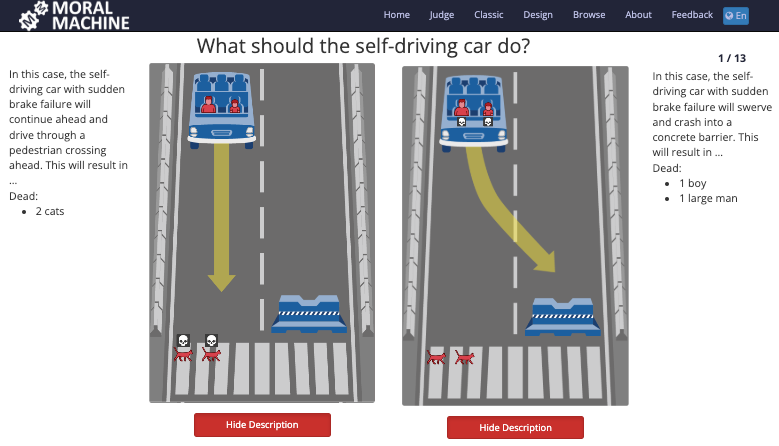
This method allows you to demonstrate how specific modules of your lecture influence the opinions. You may want to stress it with some impactful activities / discussion. For example, in the self-driving lecture / activity, you might introduce the "Moral Machine" project, a discussion on how AI handles ethical dilemmas (like the Trolley Problem).
The Result: I often find that after discussing the Moral Machine (even if I am emphasizing that it is a social experiment, not an actual algorithm on how self-driving vehicles make a decision), trust in self-driving vehicles (Q4) drops a lot.
The Lesson: This teaches students about Framing Effects. I try to have 3-4 minutes in the end to discuss this effect after demonstrating a drop in their own opinions. It also helps me to show that technical capability isn't the only factor in new technology adoption, ethical ambiguity scares people away too.
Why You Should Use It?
Implementing this tools achieves three distinct pedagogical goals:
It Demonstrates the Power of "Framing"
By introducing a variable like the "Moral Machine" or "Hallucination Risk" midway through, you can show how the context of information changes the reception of technology. When students see their own trust scores drop after an ethical discussion, they learn a critical lesson: engineering success isn't just about code; it’s about how that code is presented and perceived by society.
It Primes the Brain for Learning
Asking questions before the content is delivered triggers a cognitive process known as "Priming." By forcing students to commit to an answer early, their brains subconsciously "hunt" for the evidence during the lecture to validate or correct their initial stance. They stop being passive listeners and become active investigators.
It Personalizes Abstract Theory
Grounding presenting materials in audience personal lives is an example of evidence-based best practices in education. By asking students to answer questions about their own safety, choices, and wallets (e.g., "Would you ride in this car?"), you instantly bridge the gap between abstract theory and personal relevance, making audience care about the material.
It Sparks Interest in Human Factors
By analyzing why Q2 (need for control) correlates with Q4 (refusal to use), and by reflecting on change in answers before and after, students learn that engineering is also about psychology and Human Factor Engineering can be the path for those who does not like math or physics.
How to do it?
I usually use Google Forms, but you can choose your preferred platform With Google Forms I can put side by side reports for before and after without the need to process answers additionally (that may not be possible). Don't forget to allow access to everyone with a link without the need to sign in!
Use QR code to convert the link and put it on the title slide, audience may do it while getting sited.
Budget 3 minutes for 'before' and at least 10 minutes for 'after' to have time to go over the results and to provide some insights.
I hope I have convinced you to use this tool. Here are sets of questions for some lectures / activities you may lead.
Topic 1: AI and Trust in Generative Models (LLMs)
Context: A lecture explaining how Large Language Models work (probability, tokens, training data) versus the perception of "thinking", "hallucination'", may be discuss LLM Arena.
Q1 (Control): How frequently do you use AI tools (like ChatGPT, Gemini, or Claude) in your daily work or studies?
Logic: Baseline usage. Should not change after the lecture. Heavy users may have "automation bias" compared to novices.
Q2 (Psychological Variable): I enjoying digging into some new problems / information for hours. (Rate your agreement with the sentence)
Logic: Measures the trade-off between speed and accuracy and personal preferences when dealing with new topic. This significantly impacts whether someone accepts AI's occasional "hallucinations."
Q3 (Knowledge / Dunning-Kruger): How confident are you that you understand how an AI generates a sentence?
Logic: Before the lecture, people think they know (it "thinks"). After explaining probabilistic token prediction, confidence often drops as they realize it is just "math, not magic."
Q4 (Key Metric): I would trust an AI system to review my medical records. (Rate your agreement with the sentence)
Logic: The intervention goal. After learning about "hallucinations" and training data bias, this number usually plummets, showing a healthier, more skeptical relationship with the tool.
Topic 2: Sustainable Transportation & Mode Choice
Context: A lecture on urban planning, the true cost of car ownership and 'free parking', and the efficiency of mass transit.
Q1 (Control): What is the approximate distance of your daily commute (one way)? and What is your most common mode choice? (You can choose just one question)
Logic: A fixed variable. Distance is a hard constraint that influences choices regardless of preference and most common mode so far, should not change based on lecture content.
Q2 (Psychological Variable): How much do you view your personal vehicle as a symbol of your social status or personal freedom? (Other options, for younger audience, can be about level of activity during the day or about environmental impacts they leave)
Logic: This captures the emotional attachment to cars. High attachment here usually correlates with resistance to public transit, regardless of efficiency arguments.
Q3 (Knowledge / Dunning-Kruger): How familiar are you with the "Total Cost of Ownership" (insurance, depreciation, fuel, parking) of a personal car vs. public transit? (This question is heavily influenced by the content of your lecture)
Logic: Most people underestimate car costs. After the lecture breaks down the math, this self-assessment shifts.
Q4 (Key Metric): If public transit took 15 minutes longer than driving but saved me $300/month, I would switch to transit. (Rate your agreement with this statement)
Logic: The "Willingness to Pay" (or willingness to wait) metric. Does the financial data presented in the lecture outweigh the convenience/status factor?


Comments